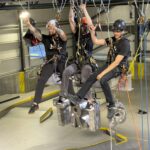
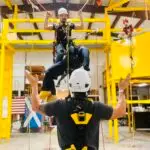
Reducing free-fall distance is an important concept in rope access. There are many ways in which we can achieve a limited free-fall distance as we’re climbing.
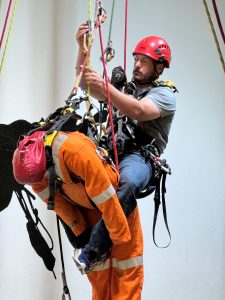
I’d like to take a moment to consider limiting free-fall distance during rescue situations.
I was thinking of something the other day, I know, I’m a nerd, and it occurred to me that some of the verbiage that we use in rope access is changing. What I mean is this:
For years, we always stressed the importance of limiting fall distance by telling our students to “control the fall factor” by keeping their back-up device as high as practical. We used the term ‘fall factor’ a lot – “watch your fall factor”, “keep that back-up high to control your fall factor”, “your fall factor is getting high, move your back-up higher”, and on, and on, and on.
The premise is great, we need to control the distance that we would free fall if our working line breaks, and a scale that essentially starts at zero and goes to 2 (most of the time in a training center) is easy to understand and practice in real-life. But the term ‘fall factor’ is losing its’ panache in our lexicon for a new term ‘control free-fall distance’. Control free-fall distance has the same ultimate meaning – put safeguard in place that will limit the free-fall distance and therefore reduce the force generated in the fall.
Now that we’re seeing a real push (mostly by SPRAT) to get rid of the term fall factor and move to controlling free-fall distance, and we have had time to analyze what it means and where it might be applied that is more appropriate than fall factor, we have to come to grips that maybe some of our techniques may have to change. One of these techniques that has occurred to me is during a rescue using conventional lanyards such as cow’s tails.
If we attach the casualty to ourselves, one point is usually some kind of short connection between the back of the descender on us and the sternal connection on the casualty. The second point is usually one of these cow’s tails. If the short connection fails, the casualty will fall a further distance than is necessary if we control the free-fall distance by using an adjustable lanyard such as a grillon or another adjustable lanyard. To help illustrate this, here’s a quick video: